

Homepage
About Us
Contact Us
Browse
Search
Cumbrian
Books
Rare Books
A selection of out-of-print and rare Cumbrian books.
Go There Now
Books in Print
Search & order from 2.2 million books in print
Categories
History
People
Outdoors
Travel Guides
Photography
The Arts
Children's
Places
Multimedia
Maps
Rare Books
All Categories
Newsletter
Click here if you would like to be added to our mailing list.
Postage
Delivery
For customers in the UK the normal delivery time is 3 working days.
View Basket
Books Cumbria
:
History
:
General
:
The Oaken Myths of Post - Conquest Britain: Symbolic Carvings from 1066
Thirlie Grundy
£9.99
Thirlie Grundy has taken a direct approach in answering previously unanswered questions about medieval carvings and their origins. The book is illustrated throughout with Thirlies own line drawings of the carvings, which show each one in clear detail.
Published by :
P3 Publications
Published Date :
2003
Pages :
137
Format :
Paperback.
Illustrations :
Line illustrations.
ISBN :
953720381
Quantity:
Review
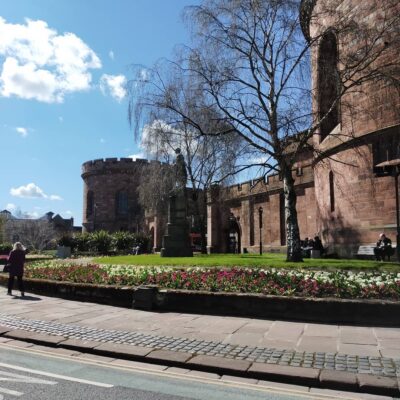
Beneath the seats of the choir stalls in Carlisle Cathedral is a unique gallery of medieval art. If you raise each one of 43 seats you will find an elaborate carving. These misericords were carved beneath the ledge of the raised seat that enabled monks and clergy to take some of the weight off their feet during the long hours of cathedral devotions.
The carvings display an array of images ranging from one of a man, possibly a Scotsman, in a short tunic being swallowed by a dragon, which may be an English dragon, to one of a woman holding a man by his beard as she is about to beat him.
The variety and exuberance of the images, showing humans, animals and mythical beasts, is usually seen to have been at the whim of the carver. In Carlisle Cathedral the seats are thought to display the imagination of craftsmen from the early fifteenth century and little has been done to explain the significance of individual images or the meaning of the whole series.
Thirlie Grundy, who lives in Carlisle, has been studying these carvings and many others in churches in Cumbria and elsewhere for many years. She is an artist and believes that the process of observing and meticulously drawing these images has given her a special insight into the traditional imagination of the medieval craftsman.
For instance, our poor belaboured husband is paying the price for not exercising his proper authority over his wife. The wife, so Thirlie suggests, has become the stronger of the two and has usurped her husbands position. Her wide-open mouth symbolizes her obnoxious breath which is caused by inner combustion, the consequence of her over-eating.
Thirlie has gone to medieval texts and bestiaries to interpret other carvings. Our Scotsman is possibly Saint Margaret. Her wide girth suggests she may be pregnant and around her girdle there appears to be two rows of pearls, which, to the medieval mind, would identify her as Margaret. Thirlie then draws on other aspects of medieval thought to show how this pure woman is submitting to the perfect Bestiary man.
Other parts of the book deal in equally close detail with the carvings on the capitals which show the twelve months of the year, and with carvings in the churches at Great Salkeld, Torpenhow, Gosforth, Lowther and Crosby Garrett, as well as further afield in Hexham, Durham and Exeter.
Thirlies theory is that in the great spate of church building after the Conquest, stonemasons were brought over from Normandy. These masons brought with them a pagan tradition of the Green man which was at odds with the Christian religion. This tradition was sustained by the craftsmen through many generations and images of this pagan spirit can be seen in many church carvings. These images show mens heads emerging from clusters of oak leaves and leaves emerging from mouths. They appeal to ancient pagan ideas with references to oak and mistletoe.
This book is one that throws down the gauntlet to much of the received academic opinion about medieval imagery. Thirlies drawings and interpretations demonstrate her extra-ordinary knowledge of her field and her arguments are developed with the aid of a fellow artists imagination.
Much of what she says is open to widely different interpretations and often the explanations seem to be peculiarly modern. However, in some ways this is a pioneering work and it should prompt others to investigate these wonderful works further.
Go to the Cathedral and raise the seats in the choir stalls and see for yourself what the craftsmen of Carlisle were carving six hundred years ago. - Steve Matthews, Bookcase.
Books Cumbria -
Terms and Conditions
How to Order
T :
+44 (0) 1228 529067
E :
info@bookscumbria.com
L :
56 Castle Street, Carlisle, Cumbria CA3 8JA
UK Web Design
by
BF Internet